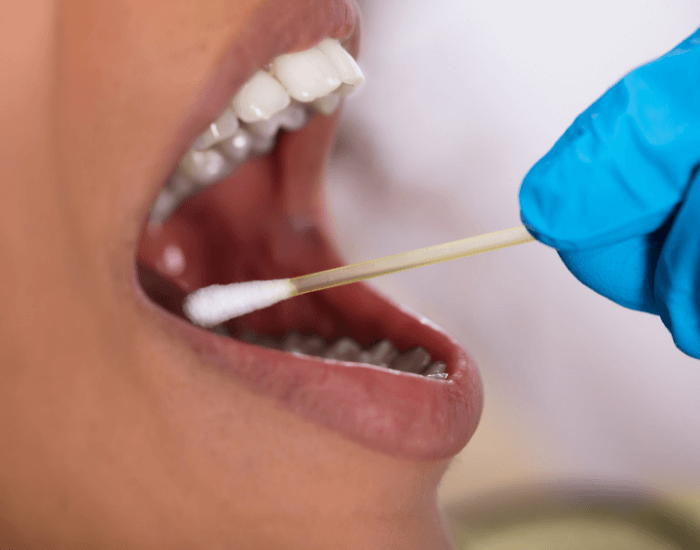
The two most popular methods for collecting DNA in labs are blood samples and cheek swabs. The DNA testing results from extracting DNA-rich cells via swabs or blood samples are exactly the same, only there are differences in how the two samples are processed. Both have different advantages. Neither has been proven to be more accurate than the other, so it ultimately depends on your preference or the lab’s ability to provide. The convenience and comfort of a cheek swab (buccal swab) makes it the clear favorite for DNA paternity testing! Let’s explore how these two methods work.
Swabs vs. Blood Samples for DNA Collection
Cheek Swabs for DNA Collection
People contributing DNA samples for paternity testing or immigration testing usually follow the normal procedures for DNA testing centers around the country, which generally use cheek swabs. There are actually several different methods for collecting DNA from your mouth area:
- Dry procedures: This requires the insertion of swabs that scrape tissue from the inside of your cheeks. This is what is most often used for paternity tests
- Wet procedure: This usually involves swishing a liquid around in your mouth and spitting the specimen into a collecting device. During this process, bacteria can also be released into your sample. This method can be used for some medical tests
- Non–invasive procedure: With some procedures, you spit out the collecting solution and another is added to eliminate bacteria and help preserve the integrity of the sample. This is the type of sample required for some ancestry tests
Depending on which procedure is used at the DNA-testing facility, a collection specialist verifies the person’s identity, gets a signed consent form, swabs the inside of the patient’s cheek, and then safely packs the DNA specimen into its safe storage.
IMPORTANT: People often confuse collecting DNA via cheek cells and collecting DNA via spit. The two are NOT interchangeable processes. If you are doing a paternity test, do not spit on the swabs. Follow directions in the kit and be sure to scrape the insides of the cheeks only. Rubbing the gums may results in collecting excess saliva. If the swabs seem too wet to put in the paper collection envelopes, your instincts are probably correct. Take a few minutes to air-dry the swabs as much as possible by holding them up and waving them in the air prior to putting them in the envelopes.
LEARN HOW TO PREVENT SAMPLE CONTAMINATION >
Pros and Cons for Swab DNA Samples
Swab collections have a number of advantages:
- No needle is used and no puncture of the skin is necessary
- It’s a quick, non-invasive procedure, with no pain involved
- The DNA collected is good indefinitely after collection if stored properly
- Scientists prefer the easier extraction process from a testing point of view
- Patients usually are more relaxed and less stressed about the DNA collection process
- They’re relatively affordable to collect
On the other side, the main cons ascribed to swabs are:
- Bacteria can attack the cells containing DNA if not dried and stored properly
- Since the cells are not visible, there is no way to visually verify DNA is present
SEE INSTRUCTIONS FOR SWABBING CHEEKS
Blood Samples for DNA Testing
The process of collecting blood works basically the same as with cheek swabs, but isn’t quite as easy—a needle is inserted to draw your blood. Some people are squeamish with needles, so there is always that initial testing apprehension. Although the majority of tests performed require only a cheek-swab sample, there are a few instances where a blood sample is required:
- Non-invasive prenatal paternity testing: A paternity test between an alleged father and an unborn child can be performed anytime after the 8th week of pregnancy. For this test, the alleged father’s DNA is collected via cheek swab, but the mother must have blood drawn. Fetal DNA is present in the mother’s bloodstream, and the baby’s DNA profile can be isolated from the mother’s, using that blood sample
- Newborn testing: Hospitals across the USA prick a baby’s heel and collect a blood sample for the purposes of newborn genetic screening
Pros and Cons for Blood DNA Samples
Taking blood samples for DNA testing do have a few pros of their own, including:
- Clean blood in proper tubes minimizes chances of contamination
- Fast and quick procedure
- Blood samples are visible
There are quite a few cons too:
- If a person has recently had a blood transfusion before a sample is drawn, the results could show two separate DNA profiles
- Needles puncture the skin—patients will feel some degree of pain
- Multiple attempts may be required to insert the needle into smaller, thinner blood veins
- Possible screaming and crying if children are required to get a DNA blood sample
- Blood samples are fast to collect, though not as quick as swab samples
Which Would You Use?
Both of these tests have their advantages and disadvantages. The bottom line is that you get highly reliable paternity test results from both. No matter which method is used , a DNA sample from your mouth is just as accurate as one from your blood sample when processed by an experienced testing laboratory.
Call us at 800-929-0847: We’re here to help.
Do you have questions or comments about DNA from cheek swabs vs. DNA from blood samples? Share in the comments and we’ll answer.


I took a prenatals non-invasive DNA test with my daughters dad while I was pregnant and the results came back 99.99 percent. Sense she looks white. He wants to take another one. He already took an at home kit DNA test from Walgreens and we just went to a lab as well and had a professional do it. Should the results be the same . Haven’t gotten results back but I will definitely update.
Hi, Nicole. If the same people’s DNA are submitted, then all results should be exactly the same. P.S. I would be wary of making any assessments that a baby “looks white.” Physical characteristics are very subjective and only DNA can determine precisely who the father is.
My wife did a cheek swab dna test on me and my 5 month old son I ate 30 minutes prior and he is still formula fed . We were in another state visiting my wife’s mom when we did the test and it wasn’t mailed until 2 days after we got home . It came back 0 percent is there anyway the dna test could’ve been wrong .
Hi, Josh. Since you were issued a result, there was no contamination of swabs due to the reasons you listed and you can be sure the result is correct for the samples provided to test. Eating/drinking or waiting to mail samples cannot change DNA.
Im 17wks pregnant n want to get a paternity test. My blood type is B+ what should my unborn baby be and what dad blood could be to be his. He wont tell me.
Hi, Kristin. Although the mother’s sample for non-invasive prenatal paternity test is blood, we don’t actually test for blood type. We test the free-floating fetal DNA in the blood to the DNA profile for the possible father. If you want to learn more, please call our experts directly at 800-929-0847 (M-F, 8 AM to 8 PM Eastern).
Hi we did a dna test and it came back 100%… Do we have 100% parental dna test? The numbers on the righten side they were matching from 1 to 15 mark.. Is it possible
A paternity showing a 100% probability of paternity? No, that is not possible unless every man in the world with the same racial background as the possible father were also tested. The highest any probability of paternity can be is 99.9%, with any number of 9s after that number, usually. Something is not right with what you’re describing.
If a blood test was drawn and sent to a Police Dept Sensitive Crime Division where dried blood from the potential father was used from a liquid blood standard and swabs of the baby and mother where using the PCR and typed for short tandem repeat (STR) loci using the Applied Biosystems AmpFISTR Profiler Plus and AmpGISTR kits..STR profiles were developed for the amplified DNA.
The mother and baby were consistent to an STR profile and so was the father concluding heim as a possible biological father. It stated that the potential father STR pfofile is at least 4.2 million times more liely that he is the biological father than some other unknown unrelated individual.
The victim (mother) in this case also had sex with the defendant’s son and cousin around the same time. Should they too be tested?
Hi, Karen. Seeing as the defendant’s son is another possible father and is a close relation to the man tested, he should also be tested, yes.
My alleged father and I took a swab DNA test. Before we took the test i drank coffee on my way to the lab which would be 15 minutes prior to test. My alleges father smoked 10 minutes prior. So we took the swab dna and I came back 0%. So is this still considered accurate.
Hi, Naomi. Drinking or smoking prior to swabbing can’t change the DNA itself: the only thing it can do is possibly contaminate the samples, making DNA extraction impossible. However, since you were issued results, drinking and smoking weren’t issues and you can trust your results.
will i as the mother get the results back before the father does?
Hi, Breanna. Online access is provided to the person who ordered the test and whose email address we have on file.
Can a DNA test via blood sample help determine if I am a chimera?
It can under specific circumstances.